Tesamorelin vs Tirzepatide Philippines: What’s the Difference?
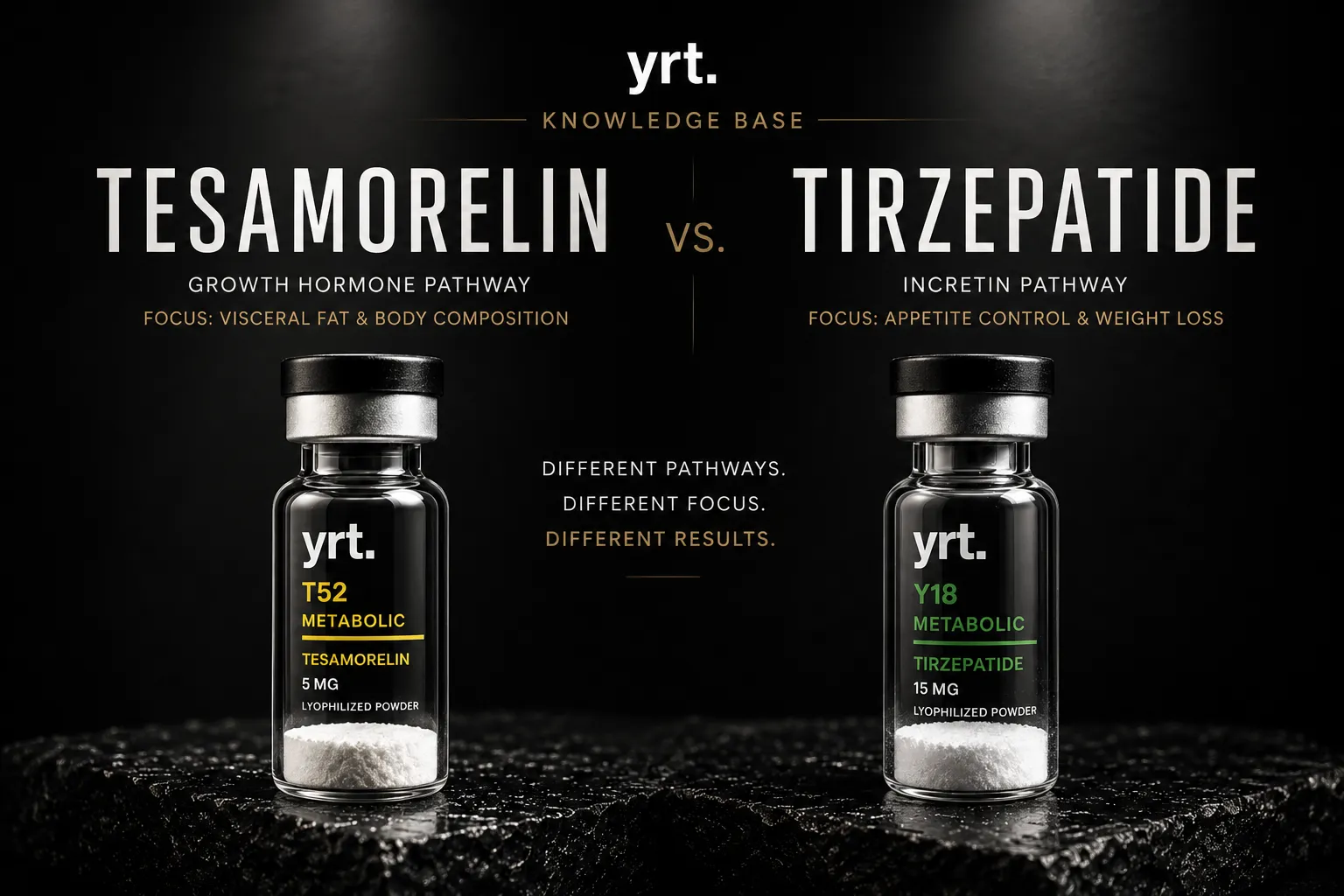
If you've been researching Tesamorelin vs Tirzepatide in the Philippines, you've probably noticed something confusing.
Both are discussed in the same metabolic-health space.
Both are associated with changes in body composition.
Both have been studied in relation to abdominal fat.
And both can appear in conversations about improving metabolic health.
But they're not interchangeable.
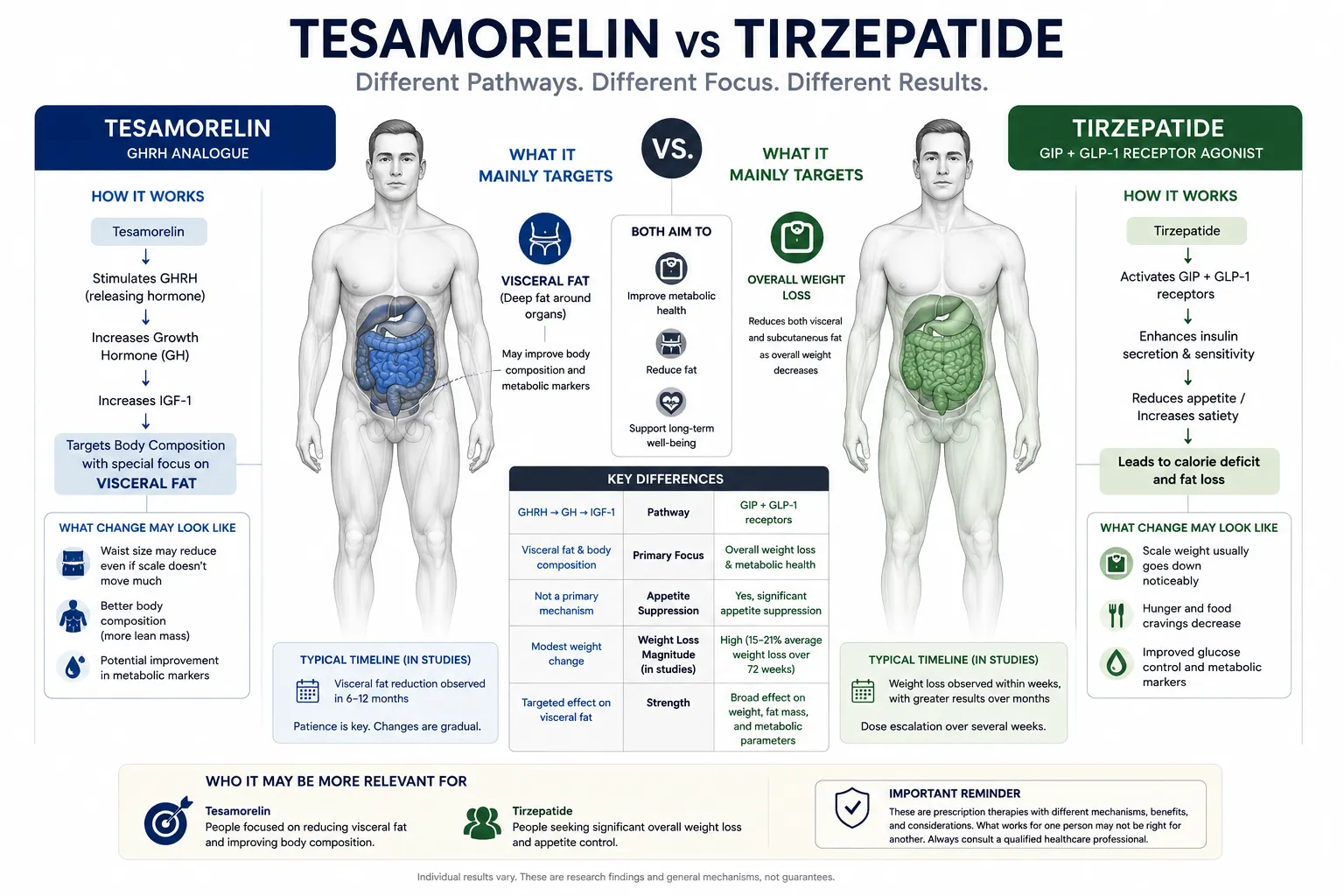
Tesamorelin works through the body's growth hormone-releasing hormone pathway and has a particularly interesting research history around visceral adipose tissue.
Tirzepatide works through GIP and GLP-1 receptor pathways and has become one of the most extensively studied medications for substantial weight reduction.
So instead of asking which one is simply “better,” it makes more sense to ask:
What are you actually trying to change?
That distinction is where the comparison becomes much more useful.
Tesamorelin and Tirzepatide Work Differently
The biggest difference is the biology.
Tesamorelin
Tesamorelin is a synthetic analogue of growth hormone-releasing hormone (GHRH).
It stimulates the body's growth hormone pathway, which subsequently affects IGF-1 and downstream processes involved in metabolism and body composition.
The simplified pathway is:
Tesamorelin → GHRH signaling → Growth hormone → IGF-1
Its clinical research has been particularly focused on visceral adipose tissue, the deeper abdominal fat stored around internal organs. Multiple randomized trials have demonstrated significant reductions in visceral adipose tissue with Tesamorelin.
Tirzepatide
Tirzepatide is a dual GIP and GLP-1 receptor agonist.
These incretin pathways influence appetite, food intake, glucose regulation and energy balance.
The simplified picture is:
Tirzepatide → GIP + GLP-1 signaling → appetite / glucose / energy balance → weight and fat reduction
In the SURMOUNT-1 trial, adults with obesity treated with once-weekly Tirzepatide experienced substantial reductions in body weight over 72 weeks, with average reductions ranging from 15.0% to 20.9% depending on dose.
Already, you can see why these two shouldn't be viewed as two versions of the same treatment.
Tesamorelin vs Tirzepatide for Weight Loss
If the question is simply:
Which has stronger evidence for overall weight loss?
That's Tirzepatide.
The evidence is considerably stronger and the magnitude of weight reduction is much greater.
In SURMOUNT-1, average weight loss at 72 weeks was:
15.0% with 5 mg
19.5% with 10 mg
20.9% with 15 mg
compared with 3.1% with placebo.
Tesamorelin has a very different clinical story.
Its established U.S. indication is not general weight-loss management. Its research has instead focused particularly on reducing visceral adipose tissue, with studies showing meaningful reductions in VAT while overall body weight may not change dramatically.
So if the primary goal is:
“I want significant overall weight loss.”
Tirzepatide has the much stronger evidence base.
But that doesn't make the Tesamorelin research irrelevant.
It simply means we're measuring different outcomes.
Tesamorelin vs Tirzepatide for Visceral Fat
This is where Tesamorelin becomes particularly interesting.
Visceral adipose tissue (VAT) is the deeper fat stored inside the abdomen around internal organs.
It isn't the same as the softer fat you can pinch underneath the skin.
Tesamorelin has been specifically studied for its effects on VAT.
In one randomized clinical trial involving people with HIV-associated abdominal fat accumulation, six months of Tesamorelin reduced visceral adipose tissue by an average of 34 cm², compared with an 8 cm² increase with placebo.
Other clinical research has found reductions in visceral fat of roughly 15–20% over 6–12 months in studied populations.
But here's the important part:
Tirzepatide can reduce visceral fat too.
Research using MRI measurements has shown reductions in visceral adipose tissue alongside reductions in abdominal subcutaneous fat and other ectopic fat with Tirzepatide.
So it would be inaccurate to say:
“Tesamorelin reduces visceral fat, while Tirzepatide doesn't.”
The better distinction is:
Tesamorelin has a particularly focused clinical research story around visceral adiposity.
Tirzepatide reduces visceral fat as part of a much broader effect on body weight and adipose tissue.
Those are different approaches.
What About Belly Fat?
This is probably where the comparison gets most confusing.
When someone says:
“I want to lose belly fat.”
they could actually mean several different things.
Subcutaneous fat
The fat directly underneath your skin.
It's the fat you can generally pinch.
Visceral fat
The fat stored deeper inside the abdominal cavity around your organs.
You can't simply grab it with your fingers.
Tesamorelin's research is particularly focused on the second category.
Tirzepatide can affect both as overall weight and fat mass decrease.
That means someone looking for substantial overall fat loss may be approaching the problem very differently from someone interested specifically in visceral adiposity and body composition.
And it's one reason the scale doesn't tell the whole story with Tesamorelin.
What About Appetite?
This is another major difference.
Tirzepatide
Appetite and food intake are an important part of the Tirzepatide story.
Its GIP and GLP-1 activity can influence hunger, satiety and food intake, which helps explain the substantial weight reductions seen in clinical trials.
Tesamorelin
Appetite suppression isn't the primary mechanism.
Tesamorelin works through the GHRH and growth hormone pathway rather than through GLP-1 or GIP receptors.
So if someone expects Tesamorelin to create the same dramatic change in hunger or food noise associated with Tirzepatide, they're expecting the wrong mechanism.
That's an important distinction.
Which One Is Better for Body Composition?
This question is harder to answer with a simple winner.
Tirzepatide produces substantial overall weight loss and reductions in fat mass.
Tesamorelin has been studied specifically for changing fat distribution, particularly visceral adipose tissue.
That means the way you evaluate progress can be different.
With Tirzepatide, you might naturally pay close attention to:
Body weight
Waist circumference
Total fat mass
Appetite
Glucose-related markers
With Tesamorelin, visceral-fat and body-composition measures become particularly interesting.
A person can therefore experience meaningful body-composition changes without seeing the same dramatic movement on the scale.
That's not a contradiction.
It's simply a reminder that body weight and body composition aren't the same measurement.
How Long Does Each Take to Work?
Neither should really be thought of as an overnight approach.
Tirzepatide's major obesity studies evaluate results over many months. In SURMOUNT-1, participants were followed for 72 weeks, including a 20-week dose-escalation period.
Tesamorelin's major visceral-fat trials have similarly evaluated outcomes over 26 weeks and longer.
For someone following a practical 12-week Tesamorelin cycle, Weeks 8–12 can be a useful point to begin assessing changes in measurements, clothing fit and overall body composition.
But that's an assessment window, not a claim that the clinical effect is complete at Week 12.
The strongest clinical evidence for Tesamorelin evaluates outcomes over longer periods.
This is also why we discussed the 90-day checkpoint in our Journal: three months can give you a better view of a gradual process than judging every week individually.
Can Tesamorelin and Tirzepatide Be Used Together?
This is one of the questions people naturally ask once they understand that the two work through different pathways.
And yes, the question makes biological sense.
Tesamorelin works through:
GHRH → GH → IGF-1
while Tirzepatide works through:
GIP + GLP-1
But different mechanisms don't automatically mean that combining them creates a proven additional benefit.
There is limited controlled clinical evidence specifically evaluating Tesamorelin plus Tirzepatide as a combination.
So while the two therapies are sometimes discussed together, we shouldn't describe the combination as an established or clinically proven “stack.”
The potential benefits, risks and appropriateness of combining therapies need to be considered individually with qualified professional guidance.
What About Retatrutide?
If you've been researching metabolic peptides in the Philippines, you've probably also encountered Retatrutide.
It is another molecule being investigated for metabolic and weight-management applications, but it works through a different receptor profile from both Tesamorelin and Tirzepatide.
Retatrutide is being studied as a triple agonist, activating GIP, GLP-1 and glucagon receptors.
That makes the comparison interesting:
Tesamorelin
→ GHRH / GH / IGF-1
Tirzepatide
→ GIP / GLP-1
Retatrutide
→ GIP / GLP-1 / glucagon
But these aren't three interchangeable options.
Retatrutide remains an investigational therapy, so its clinical evidence should be interpreted differently from the established evidence base surrounding Tirzepatide.
We'll explore that comparison in more detail separately.
Tesamorelin vs Tirzepatide in the Philippines
For someone searching Tesamorelin vs Tirzepatide Philippines, the most useful thing to understand is that these molecules shouldn't be compared simply by price, popularity or how many kilograms someone else lost.
They're being studied for different metabolic outcomes.
Tirzepatide
Has extensive clinical evidence for substantial overall weight reduction and metabolic improvements in people with obesity and related conditions.
Tesamorelin
Has a more focused research story around visceral adipose tissue and body composition, particularly in populations studied for abdominal adiposity.
So the more useful question isn't:
“Which peptide is stronger?”
It's:
“What outcome am I actually trying to change?”
That distinction becomes especially important when researching these therapies in the Philippines, where the online conversation can sometimes make very different molecules sound interchangeable.
They aren't.
Frequently Asked Questions
If your main goal is overall weight loss, Tirzepatide has the stronger track record. It works heavily through appetite control, helping reduce hunger and food intake while supporting broader fat loss. Tesamorelin is different. Its focus is less about moving the number on the scale and more about body composition and visceral fat — the deeper abdominal fat stored around the organs. So it's less about which one is “better” and more about what you're trying to change.
Yes. Because they work through different pathways, Tesamorelin and Tirzepatide can be used as part of the same approach. Tirzepatide primarily works on appetite, energy intake and overall weight and fat loss, while Tesamorelin works through the growth hormone pathway, with a particular focus on visceral adipose tissue. In simple terms: Tirzepatide → helps reduce overall weight and fat Tesamorelin → targets body composition with a focus on deeper visceral fat That's why the two are sometimes considered together when the goal goes beyond simply seeing a lower number on the scale.
Yes. Tirzepatide can reduce visceral adipose tissue as overall weight and fat mass decrease. Its broader effect is on appetite, energy intake, weight and metabolic health, so visceral-fat reduction is part of that bigger picture. Tesamorelin approaches visceral fat differently, working through the growth hormone pathway with visceral adiposity as one of its most studied areas.
The easiest way to think about it is different pathways, different focus. Tesamorelin: GHRH → growth hormone → IGF-1 → body composition and visceral fat. Tirzepatide: GIP + GLP-1 → appetite, satiety, glucose regulation and overall weight loss. They're both part of the metabolic-health conversation, but they're not doing the same job.
Retatrutide takes yet another approach. It is being studied as a triple agonist, acting on GIP, GLP-1 and glucagon receptors. That puts it closer to Tirzepatide in the sense that both are incretin-based metabolic therapies, while Tesamorelin works through the GHRH/growth hormone pathway. A simple way to see the difference: Tesamorelin → GHRH / GH / IGF-1 Tirzepatide → GIP / GLP-1 Retatrutide → GIP / GLP-1 / glucagon
Not in the same way Tirzepatide does. Appetite suppression isn't the main reason Tesamorelin is interesting. Its primary pathway involves GHRH, growth hormone and IGF-1, while Tirzepatide's GIP and GLP-1 activity has a much more noticeable effect on hunger and satiety.
No. Tesamorelin is a GHRH analogue that works through the growth hormone pathway. Tirzepatide is a GIP + GLP-1 receptor agonist. They're completely different molecules working through different biological pathways.
ot necessarily — and that's not really what Tesamorelin is known for. Tirzepatide is designed around a much broader effect on appetite, energy intake and overall weight reduction. Tesamorelin is more interesting when you're looking at where fat is stored and how body composition changes, particularly visceral fat. So someone can see meaningful body-composition changes with Tesamorelin without seeing the same dramatic scale movement associated with Tirzepatide.
It depends on what you mean by belly fat. Tirzepatide can reduce overall body fat, including both visceral and subcutaneous fat, as weight decreases. Tesamorelin has a particularly strong focus on visceral fat — the deeper abdominal fat surrounding the organs. So if you're talking about overall belly and body-fat reduction, Tirzepatide has the broader effect. If you're specifically interested in visceral adiposity and body composition, Tesamorelin has a very different and interesting role.
Both are measured in weeks and months rather than days, but the way you notice the changes can be different. Tirzepatide can produce noticeable changes in appetite and weight relatively early, with results continuing to build over time. Tesamorelin is more gradual. Changes in visceral fat and body composition are better evaluated over a longer period, which is why a 90-day checkpoint can be useful for looking at waist measurements, clothing fit and overall changes rather than expecting an overnight transformation.
Tesamorelin and Tirzepatide are sometimes placed next to each other as though they're competing versions of the same idea.
They're not.
Tirzepatide has become a major force in weight management because it can produce substantial overall weight loss through GIP and GLP-1 signaling.
Tesamorelin has a different story — one centered around the growth hormone pathway and its particularly interesting effects on visceral adipose tissue.
And that's why the comparison becomes much more useful when we stop asking:
“Which one wins?”
and start asking:
“What are we actually trying to change?”
If the goal is substantial overall weight reduction, the Tirzepatide evidence is compelling.
If the conversation is specifically about visceral adiposity and body composition, Tesamorelin has a different and much more focused research story.
Neither needs to be exaggerated to be interesting.
Different pathways. Different evidence. Different outcomes.
That's what makes understanding the difference more valuable than simply choosing a favorite.
This article is for general education and does not constitute medical advice. Speak with your care team or a qualified healthcare professional before acting on anything here.
Explore the Tesamorelin or Tirzepatide Protocol
Want to explore Tesamorelin or Tirzepatide beyond the research? Learn more about the YRT protocol, including what it is, how it fits within the YRT system, and what to know before taking the next step.
Explore the Tesamorelin Protocol →
Explore the Tirzepatide Protocol →