Tirzepatide: Why This Dual-Action Peptide Changed Weight Management
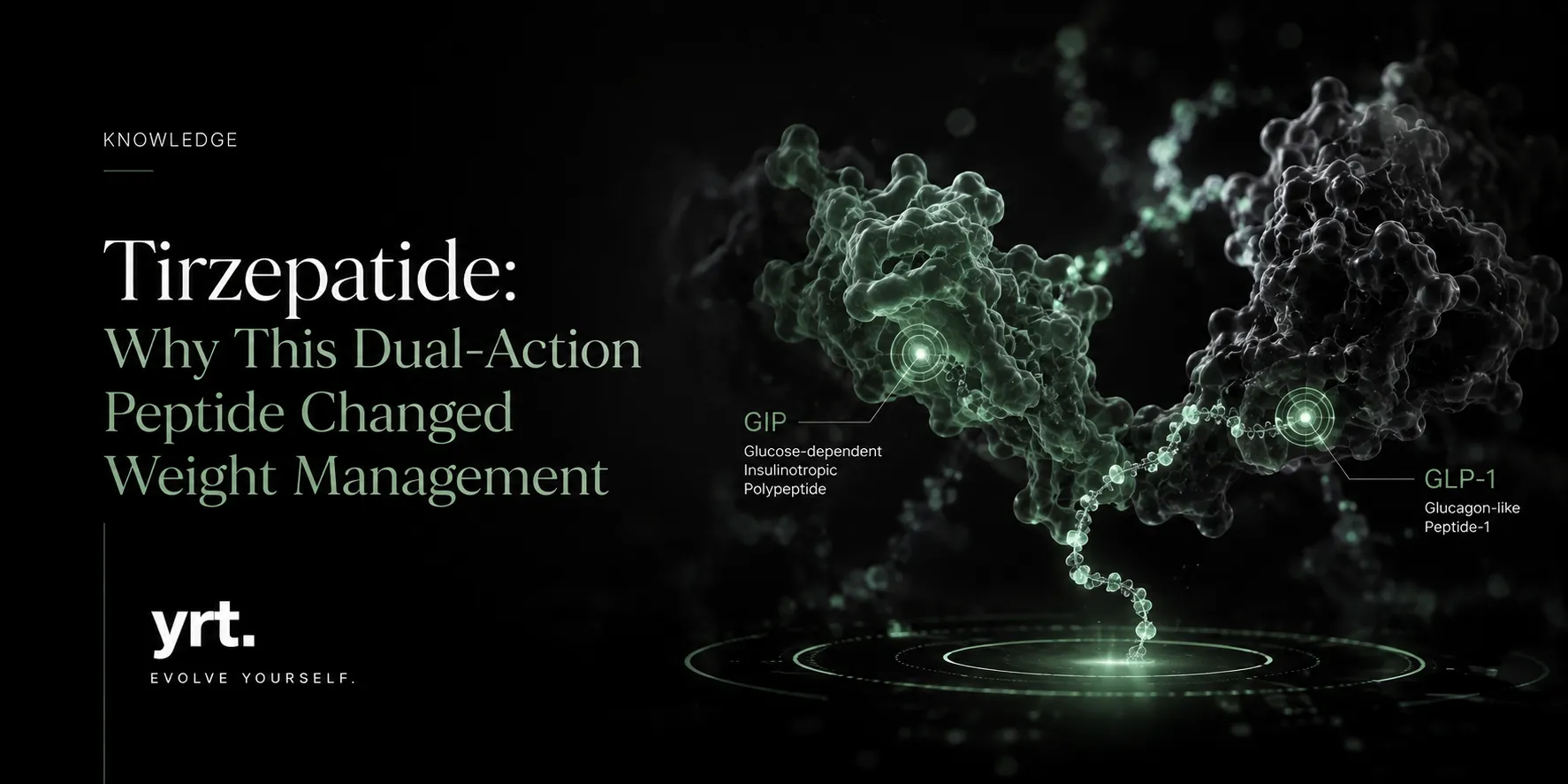
If you've been researching weight management, you've almost certainly come across Tirzepatide.
It is one of the compounds that helped change the way we think about metabolic treatment — not because it simply suppresses appetite, but because it works through two different hormone pathways at the same time.
Tirzepatide activates both GIP and GLP-1 receptors.
That dual action has produced some remarkable results in clinical research. In the landmark SURMOUNT-1 trial, people receiving the highest studied dose lost an average of 20.9% of their body weight after 72 weeks, compared with 3.1% with placebo.
More recent research has also shown that the effects can be sustained over several years when treatment is continued.
So what makes Tirzepatide different, and why has it become such a major part of the metabolic-health conversation?
What Is Tirzepatide?
Tirzepatide is a synthetic peptide that activates two incretin hormone receptors:
GIP — glucose-dependent insulinotropic polypeptide
GLP-1 — glucagon-like peptide-1
This is why Tirzepatide is often described as a dual agonist.
The molecule is available under the brand name Mounjaro for type 2 diabetes and Zepbound for chronic weight management in the United States. The FDA approved Zepbound for adults with obesity, or adults who are overweight with at least one weight-related condition, alongside diet and physical activity.
But the interesting part isn't simply that Tirzepatide activates two receptors.
It's what those two pathways do together.
How Does Tirzepatide Work?
Tirzepatide works through both GIP and GLP-1 signaling, which influence several aspects of metabolism.
GLP-1
GLP-1 signaling can reduce appetite, slow gastric emptying and influence glucose regulation.
This is the pathway people are generally familiar with from medications such as semaglutide.
GIP
GIP is another incretin hormone involved in insulin secretion and energy metabolism.
Tirzepatide's ability to activate GIP alongside GLP-1 is what separates it from traditional GLP-1-only treatments.
Together, these pathways can influence:
Appetite and food intake
Blood glucose regulation
Insulin sensitivity
Gastric emptying
Body weight
Overall energy balance
The result is not simply eating less.
It's a broader change in the signals that help regulate hunger, glucose and metabolism.
Why Did Tirzepatide Change Weight Management?
The answer comes down to the results.
Before Tirzepatide, GLP-1-based therapies had already demonstrated that targeting metabolic hormones could produce meaningful weight loss.
Tirzepatide pushed that concept further by adding GIP activity.
In SURMOUNT-1, adults with obesity or overweight and a weight-related condition received weekly Tirzepatide for 72 weeks. Average weight reduction reached:
15.0% with 5 mg
19.5% with 10 mg
20.9% with 15 mg
compared with 3.1% with placebo.
Even more striking, 36% of participants receiving 15 mg achieved at least 25% weight loss during the trial.
Those results helped establish Tirzepatide as one of the most powerful pharmacological approaches to weight management studied to date.
What Does the Latest Research Show?
The Tirzepatide story hasn't stopped at 72 weeks.
Longer-term research has continued to show substantial and sustained weight reduction.
In a three-year analysis of people with obesity and prediabetes, continued Tirzepatide treatment produced sustained weight reduction and substantially reduced progression to type 2 diabetes compared with placebo. No new safety signals were identified in that analysis.
Another important study asked a very practical question:
What happens when people switch from Tirzepatide to placebo?
In SURMOUNT-4, participants first received Tirzepatide for 36 weeks and achieved an average 20.9% reduction in body weight. Those who continued treatment lost an additional 5.5% during the following year, while those switched to placebo regained approximately 14% of their body weight.
That finding highlights an important part of modern weight management:
The biology doesn't necessarily stop responding when the medication stops.
Tirzepatide can be extremely effective, but maintaining the result is also part of the equation.
How Long Does Tirzepatide Take to Work?
Tirzepatide is a gradual treatment, but many people begin noticing changes relatively early.
Appetite and food-intake changes can appear during the first few weeks, while changes in body weight tend to build progressively over the following weeks and months.
A 12-week period is a useful early milestone for assessing response. By this point, many people have had enough time to see meaningful changes in appetite, eating patterns and body weight, although individual results can vary.
The clinical trials show that the process continues well beyond 12 weeks.
In SURMOUNT-1, participants continued losing weight throughout the 72-week study period, with the highest-dose group averaging 20.9% weight reduction at the final assessment.
So the first 12 weeks can be thought of as the beginning of the response, rather than the finish line.
Tirzepatide vs. Semaglutide
This is one of the most common questions in the metabolic space.
Semaglutide primarily activates the GLP-1 receptor.
Tirzepatide activates GIP + GLP-1.
And we now have direct clinical evidence comparing them.
In SURMOUNT-5, adults with obesity but without type 2 diabetes received the maximum tolerated dose of Tirzepatide or Semaglutide for 72 weeks.
Tirzepatide produced an average 20.2% reduction in body weight, compared with 13.7% with Semaglutide.
Tirzepatide also produced a greater reduction in waist circumference: approximately 18.4 cm versus 13.0 cm.
That makes this one of the rare cases where we have a direct head-to-head comparison rather than simply comparing results from separate trials.
Tirzepatide vs. Retatrutide
This is where the next generation of metabolic research gets interesting.
Tirzepatide activates:
GIP + GLP-1
Retatrutide activates:
GIP + GLP-1 + glucagon
That additional glucagon pathway is the defining difference.
Retatrutide's clinical results have generated enormous interest, with Phase 3 trials reporting even larger average weight reductions than those seen in earlier Tirzepatide studies.
But the two molecules have not been definitively compared head-to-head in the same large obesity trial, so it would be premature to declare one universally “better.”
What we can say is that Tirzepatide helped establish the potential of dual-pathway metabolic treatment, while Retatrutide is exploring what happens when a third pathway is added.
What Are the Potential Benefits of Tirzepatide?
The most obvious effect is weight reduction, but the research extends beyond the scale.
Tirzepatide has been studied extensively for:
Weight management
Type 2 diabetes
Blood glucose control
Insulin sensitivity
Waist circumference
Cardiometabolic risk factors
Diabetes prevention in people with obesity and prediabetes
The longer-term SURMOUNT-1 analysis is particularly interesting because it showed both sustained weight reduction and a substantially lower risk of progressing from prediabetes to type 2 diabetes during the study period.
This is one reason Tirzepatide is increasingly viewed as a metabolic therapy, rather than simply a weight-loss injection.
What Are the Common Side Effects?
The most commonly reported side effects of Tirzepatide are gastrointestinal.
These can include:
Nausea
Diarrhea
Vomiting
Constipation
Abdominal discomfort
In the major obesity trials, gastrointestinal effects were generally mild to moderate and occurred most often during the dose-escalation period.
The gradual dose-escalation approach used in clinical trials is one reason treatment is not typically started at the highest dose.
Tirzepatide also carries important prescribing considerations and is not appropriate for everyone. Anyone considering treatment should discuss their medical history and other medications with a qualified healthcare professional.
Tirzepatide in the Philippines
Interest in Tirzepatide Philippines has grown rapidly alongside the global popularity of Mounjaro and Zepbound.
Tirzepatide is now one of the most recognizable names in metabolic health, and people in the Philippines increasingly encounter both branded and compounded products when researching their options.
The key distinction is that Tirzepatide itself has an extensive clinical evidence base, while the quality, source and regulatory status of an individual product are separate questions.
In the United States, Tirzepatide is marketed as Mounjaro for type 2 diabetes and Zepbound for chronic weight management.
Local availability, prescribing requirements and the regulatory status of specific products can differ in the Philippines and may change over time.
For anyone researching Tirzepatide PH, understanding the molecule is the first step — but understanding where a particular product comes from is just as important.
Frequently Asked Questions
Tirzepatide is a once-weekly peptide that activates both GIP and GLP-1 receptors. It has been extensively studied for type 2 diabetes and weight management.
Not exactly. Tirzepatide activates the GLP-1 receptor, but it also activates the GIP receptor. That's why it is classified as a dual GIP/GLP-1 receptor agonist rather than a GLP-1-only medication.
Some people notice appetite and food-intake changes within the first few weeks. More visible changes in body weight generally build over time. A 12-week period provides a useful early picture of response, but clinical studies show that weight reduction can continue for many months.
Results vary by person, dose and treatment duration. In SURMOUNT-1, average weight reduction at 72 weeks was 15.0% with 5 mg, 19.5% with 10 mg and 20.9% with 15 mg.
Yes. Mounjaro is a brand name for Tirzepatide. Tirzepatide is the active molecule.
Weight regain can occur after stopping. In SURMOUNT-4, participants who switched from Tirzepatide to placebo after an initial treatment period regained a substantial portion of the weight they had lost, while participants who continued Tirzepatide maintained and extended their weight reduction.
There is no established clinical basis for combining the two. Both act on overlapping metabolic pathways, and Retatrutide itself remains investigational. Combining therapies should only be considered under appropriate medical supervision.
Final Thoughts
Tirzepatide didn't become one of the biggest names in metabolic health by accident.
It took an idea that was already changing medicine — incretin-based treatment — and pushed it further by combining GIP and GLP-1 signaling in a single molecule.
The results have been substantial.
Large clinical trials have demonstrated significant weight reduction, improvements in metabolic health, and sustained benefits with continued treatment. Direct comparison with Semaglutide has also shown Tirzepatide producing greater average reductions in both body weight and waist circumference.
And perhaps the most interesting part is that the research is still evolving.
Tirzepatide has helped establish just how powerful multi-pathway metabolic therapies can be — setting the stage for the next generation of compounds such as Retatrutide.
For now, Tirzepatide remains one of the most extensively studied and influential therapies in modern metabolic medicine.
Two pathways. One molecule. A very different way of thinking about weight and metabolic health.
This article is for general education and does not constitute medical advice. Speak with your care team or a qualified healthcare professional before acting on anything here.
Explore the Tirzepatide Protocol
Want to explore GHK-Cu beyond the research? Learn more about the YRT protocol, including what it is, how it fits within the YRT system, and what to know before taking the next step.