MOTS-c: The Mitochondrial Peptide Changing the Metabolic Conversation

If most of the peptides you've heard about come from hormones, growth factors, or the gastrointestinal system, MOTS-c is different.
It comes from the mitochondria.
Mitochondria are often introduced as the “powerhouses” of the cell, but they do much more than produce energy. They also participate in cellular signaling, stress responses, and communication with the rest of the cell.
MOTS-c is one of the small peptides researchers have identified within that mitochondrial signaling system.
And that's what makes it so interesting.
Rather than primarily targeting appetite like a GLP-1, or growth-hormone signaling like Tesamorelin, MOTS-c is being investigated much closer to the cellular energy and metabolic regulation level.
What Is MOTS-c?
MOTS-c stands for mitochondrial open reading frame of the 12S rRNA type-c.
It is a naturally occurring 16-amino-acid mitochondrial-derived peptide, encoded within the mitochondrial genome rather than the nuclear genome.
Researchers first described MOTS-c in 2015 and identified it as a potential regulator of metabolic homeostasis. Early research found effects involving glucose metabolism and insulin sensitivity, particularly in skeletal muscle.
Since then, research has expanded into:
Insulin sensitivity
Glucose metabolism
Exercise adaptation
Energy balance
Obesity
Metabolic aging
Cellular stress responses
That gives MOTS-c a very different identity from the better-known appetite and weight-management peptides.
It isn't simply another compound designed to make someone eat less.
It's being investigated as part of the body's mitochondrial response to metabolic stress.
How Does MOTS-c Work?
MOTS-c doesn't appear to work through one simple pathway.
One of the most studied mechanisms involves AMPK, or AMP-activated protein kinase.
AMPK acts as an energy sensor inside cells, helping regulate how cells respond when energy demands change.
Research suggests MOTS-c can influence the folate and purine metabolic pathways, increasing AICAR-related signaling and activating AMPK. This can influence glucose utilization and broader metabolic adaptation.
Research has also found that MOTS-c can respond to stress and exercise and, under certain conditions, move into the nucleus where it can influence genes involved in cellular stress adaptation.
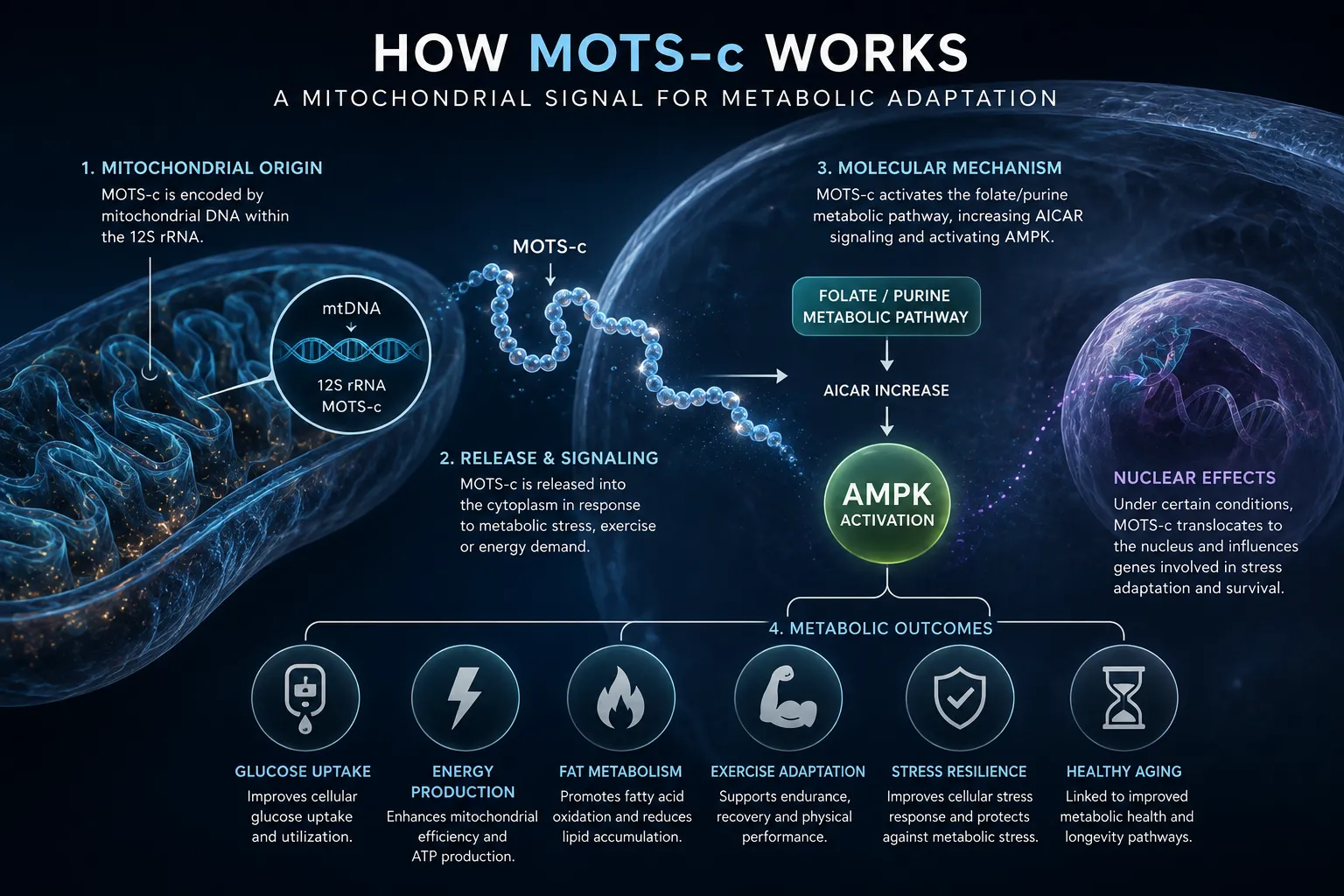
The simplified picture is:
MOTS-c
↓
Cellular metabolic signaling
↓
AMPK / energy-sensing pathways
↓
Glucose utilization · metabolic adaptation · stress response
That's what makes MOTS-c particularly interesting.
Its research isn't centered on one visible outcome.
It's centered on how cells manage energy.
Why Is MOTS-c Getting So Much Attention?
Because the question behind it is different.
A GLP-1-based approach asks:
How can we influence appetite, food intake and glucose regulation?
Tesamorelin asks:
How can we influence the growth-hormone pathway and visceral fat?
MOTS-c asks:
What happens when we influence the body's cellular energy-sensing machinery?
Preclinical research has produced intriguing results. In animal models, MOTS-c has been associated with improved insulin sensitivity, glucose handling, and protection against diet-induced metabolic dysfunction.
Human observational research has also found associations between circulating MOTS-c and metabolic states, although those findings have not been completely consistent across populations. A meta-analysis of human observational studies found significant differences in circulating MOTS-c across some metabolic conditions while also highlighting substantial heterogeneity between studies.
That distinction is important.
The biology is interesting.
The human therapeutic evidence is still developing.
MOTS-c and Insulin Sensitivity
One of the most important areas of MOTS-c research is insulin sensitivity.
Insulin sensitivity describes how effectively the body's cells respond to insulin.
When insulin sensitivity decreases, the body may need to produce more insulin to achieve the same effect. Over time, reduced insulin sensitivity can contribute to metabolic dysfunction and type 2 diabetes.
Human studies have investigated the relationship between naturally circulating MOTS-c and measures of insulin sensitivity and metabolic health.
But observational research can't answer the bigger question:
What happens when MOTS-c is actually administered to a person?
That's where the current clinical research becomes particularly interesting.
The Human Trial to Watch
A Phase 2a randomized, double-blind, placebo-controlled clinical trial is currently investigating MOTS-c in adults with prediabetes and overweight or obesity.
The study, registered as MOTS-MET / NCT07505745, is designed to evaluate whether administered MOTS-c can improve insulin sensitivity compared with placebo.
The trial is also measuring metabolic outcomes including glucose markers, body weight and waist circumference, along with safety and tolerability.
The treatment period is 12 weeks, making it particularly relevant to the way people are currently thinking about MOTS-c protocols.
But there is an important distinction:
The trial is ongoing.
We don't yet have the results showing what MOTS-c ultimately does in this population.
That means the excitement around this study comes from the fact that researchers are finally testing the hypothesis in a controlled human setting — not because the answer is already known.
MOTS-c and Exercise
MOTS-c has another fascinating connection:
exercise.
Research suggests that exercise can influence mitochondrial-derived peptide signaling, including MOTS-c. This has led researchers to investigate whether MOTS-c forms part of the body's natural response to physical activity and metabolic stress.
This is where you'll sometimes see MOTS-c described as an “exercise mimetic.”
The phrase needs some context.
MOTS-c isn't exercise in a vial.
Rather, some of the cellular pathways associated with MOTS-c overlap with pathways activated during exercise and metabolic stress.
That's why researchers are interested in its potential relationship with exercise adaptation, metabolic flexibility and cellular energy regulation.
And it makes the science more interesting, not less:
Exercise doesn't just burn energy. It sends signals that tell the body to adapt.
MOTS-c may be part of that signaling network.
Does MOTS-c Help With Weight Loss?
This is one of the most common questions.
The answer is different from Tirzepatide or Retatrutide.
MOTS-c is not primarily an appetite-suppressing peptide.
The interest around body composition comes from its potential effects on energy metabolism, glucose handling and insulin sensitivity.
Animal studies have reported reductions in weight gain and improvements in metabolic health under certain experimental conditions.
But we do not yet have large randomized human trials demonstrating that administered MOTS-c produces a specific percentage of weight loss.
The current Phase 2a study is measuring body weight and waist circumference, but its primary focus is insulin sensitivity.
So for now, MOTS-c is better understood as a metabolic research peptide than as another direct weight-loss drug.
How Long Does MOTS-c Take to Work?
MOTS-c is generally discussed as a gradual metabolic and cellular-signaling approach rather than something expected to create an immediate change.
People exploring MOTS-c commonly look for changes in energy, exercise tolerance, recovery or metabolic response over several weeks.
However, these reports are largely anecdotal, and there isn't enough controlled human evidence to establish a universal timeline.
The current human trial uses a 12-week treatment period, making 12 weeks an important research timeframe — but not a guaranteed personal-results timeline.
For MOTS-c, the more interesting question may not be:
“How quickly will I lose weight?”
but:
“Is my metabolic function changing?”
That's much closer to what researchers are actually trying to understand.
MOTS-c vs. GLP-1 Peptides
MOTS-c and GLP-1-based therapies work through very different biological pathways.
GLP-1 therapies primarily influence appetite, food intake, gastric emptying and glucose regulation.
MOTS-c is being investigated for its effects on mitochondrial signaling, cellular energy metabolism, insulin sensitivity and metabolic adaptation.
So MOTS-c isn't simply a weaker version of a GLP-1.
It is a fundamentally different approach to metabolic biology.
MOTS-c vs. Tirzepatide
The difference becomes even clearer with Tirzepatide.
Tirzepatide activates:
GIP + GLP-1
MOTS-c is associated with:
Mitochondrial signaling + metabolic adaptation
Tirzepatide has extensive randomized human evidence demonstrating substantial weight loss.
MOTS-c does not yet have that level of clinical evidence.
So this isn't really a question of which peptide is “stronger.”
They are being investigated for different biological jobs.
MOTS-c and Healthy Aging
This is probably the most futuristic part of the MOTS-c story.
As we age, mitochondrial function and metabolic flexibility can change.
Researchers have therefore become interested in mitochondrial-derived peptides as potential signals involved in metabolic aging and cellular stress responses.
MOTS-c has been investigated in relation to:
Metabolic aging
Exercise adaptation
Insulin sensitivity
Muscle function
Cellular stress responses
Age-related metabolic changes
This is why you'll often see MOTS-c described online as an “anti-aging peptide.”
But that phrase is broader than the current human evidence supports.
A more accurate description is:
MOTS-c is a mitochondrial-derived signaling peptide being investigated for its potential role in metabolic health, cellular stress responses and age-related changes in energy regulation.
That's already pretty fascinating.
What Are the Potential Benefits of MOTS-c?
The major areas of research include:
Insulin sensitivity
MOTS-c is being investigated for its potential effects on how cells respond to insulin and handle glucose.
Metabolic flexibility
Researchers are studying whether MOTS-c can influence how cells adapt their energy use under different metabolic conditions.
Exercise adaptation
Its relationship with exercise-related signaling makes MOTS-c particularly interesting in sports and metabolic research.
Mitochondrial signaling
Its origin within mitochondrial DNA makes it a unique molecule for studying communication between mitochondria and the rest of the cell.
Body composition
Animal research has reported effects on weight gain and metabolic health, while human trials are now beginning to measure changes in weight and waist circumference.
Healthy aging
MOTS-c is part of a growing area of research examining how mitochondrial signaling may influence metabolic changes associated with aging.
The common thread is metabolic signaling, not appetite suppression.
What About Side Effects?
This is an area where the evidence is still developing.
There isn't yet a large completed clinical safety database for administered MOTS-c.
The current Phase 2a study is designed to collect safety and tolerability information alongside its metabolic outcomes.
That doesn't mean MOTS-c is known to be unsafe.
It means the human safety database is still being built.
This distinction is particularly important when discussing an investigational peptide: the biological potential of a molecule and the safety profile of a particular administered product are two separate questions.
MOTS-c in the Philippines
Interest in MOTS-c Philippines has grown alongside the global interest in mitochondrial health, metabolic optimization, longevity and peptide-based approaches.
The molecule is particularly interesting to people looking beyond conventional appetite-focused approaches and toward cellular metabolism, energy regulation and healthy aging.
But the most important development isn't its popularity online.
It's the research.
The current Phase 2a trial is specifically investigating MOTS-c in adults with prediabetes and overweight or obesity, making it one of the most relevant developments to follow as the science moves from laboratory research into human clinical investigation.
Frequently Asked Questions
MOTS-c is a naturally occurring 16-amino-acid mitochondrial-derived peptide encoded within mitochondrial DNA. Researchers are studying its role in metabolic signaling, insulin sensitivity, exercise adaptation and cellular stress responses.
MOTS-c is being investigated for effects on cellular energy regulation, glucose metabolism, insulin sensitivity and metabolic adaptation. AMPK-related signaling is one of the major mechanisms studied.
MOTS-c is not primarily an appetite-suppressing peptide. Animal research has shown effects on weight gain and metabolic health, but human research is still developing. The current Phase 2a trial is measuring body weight and waist circumference alongside insulin sensitivity.
Increased energy and endurance are commonly discussed in peptide communities, and MOTS-c's relationship with mitochondrial and exercise signaling provides a biological reason for that interest. However, increased energy has not yet been established as a consistent clinical outcome in large controlled human trials.
MOTS-c is sometimes described as an exercise-mimetic peptide because some of its associated metabolic pathways overlap with pathways activated by exercise. The term describes biological similarities; it does not mean MOTS-c replaces exercise.
MOTS-c and Tirzepatide act through different biological pathways and are commonly discussed together in metabolic-health and peptide communities. Controlled clinical research specifically evaluating the combination is limited, however, so it should be approached thoughtfully with appropriate professional guidance.
The two compounds act through different pathways and are discussed together in peptide communities. However, Retatrutide remains investigational, and there is currently no robust clinical evidence establishing the safety or added benefit of combining it with MOTS-c.
No. MOTS-c is a mitochondrial-derived peptide and does not belong to the GLP-1 drug class. Its research centers on mitochondrial signaling and metabolic adaptation rather than primarily targeting the GLP-1 receptor.
MOTS-c may be one of the most conceptually interesting peptides in the current metabolic-health conversation.
Not because it's another appetite suppressant.
Not because it promises a shortcut around exercise.
But because it comes from the mitochondria themselves.
Researchers are increasingly recognizing that mitochondria aren't simply cellular batteries. They participate in signaling systems that communicate information about energy, stress, exercise and metabolism.
MOTS-c appears to be part of that conversation.
The preclinical research has given scientists plenty of reasons to investigate it, while human observational research has started connecting naturally circulating MOTS-c with metabolic health.
And now the field has reached an important next step.
A controlled Phase 2a human trial is investigating whether administered MOTS-c can improve insulin sensitivity in people with prediabetes and overweight or obesity.
We don't know the outcome yet.
And that's okay.
The interesting part is that we're finally getting closer to finding out.
MOTS-c isn't simply another peptide being discussed because it's trendy.
It's a glimpse into the possibility of influencing metabolism at the mitochondrial level — and the human research is only beginning to tell us what that could actually mean.
This article is for general education and does not constitute medical advice. Speak with your care team or a qualified healthcare professional before acting on anything here.
Explore the Mots-C Protocol
Want to explore Mots - Cbeyond the research? Learn more about the YRT protocol, including what it is, how it fits within the YRT system, and what to know before taking the next step.