BPC-157: Why This Repair Peptide Has Everyone Talking
If there is one peptide that seems to come up whenever people talk about recovery, injuries, tendons, gut health, or tissue repair, it is BPC-157.
It has become especially popular among athletes, active people, and peptide enthusiasts looking for something different from traditional recovery approaches.
But BPC-157 is also one of the peptides where the conversation online can get ahead of the science.
That's not because the research is boring.
Quite the opposite.
BPC-157 has generated a remarkably large body of laboratory and animal research exploring tissue repair, blood-vessel formation, inflammation, gastrointestinal injury, tendon healing, and more.
What has been missing for a long time is large-scale human research.
That is beginning to change.
So what exactly is BPC-157, why has it become so popular, and what does the research actually tell us?
What Is BPC-157?
BPC-157 is a synthetic 15-amino-acid peptide, commonly referred to as Body Protection Compound 157 or the stable gastric pentadecapeptide.
The sequence is:
GEPPPGKPADDAGLV
BPC-157 became particularly interesting because researchers observed biological activity across a surprisingly broad range of experimental models.
Research has investigated its potential effects on gastrointestinal tissue, tendons, ligaments, muscles, blood vessels, skin, and nervous-system-related processes.
That broad range is one reason BPC-157 is sometimes described as a repair or regenerative peptide.
It isn't a hormone like GLP-1 or growth hormone.
Instead, researchers are investigating how it may influence several biological signaling systems involved in tissue protection and repair.
How Does BPC-157 Work?
BPC-157 doesn't appear to work through a single pathway.
One of the most studied areas is its relationship with the nitric oxide (NO) system, which plays an important role in blood flow and vascular function.
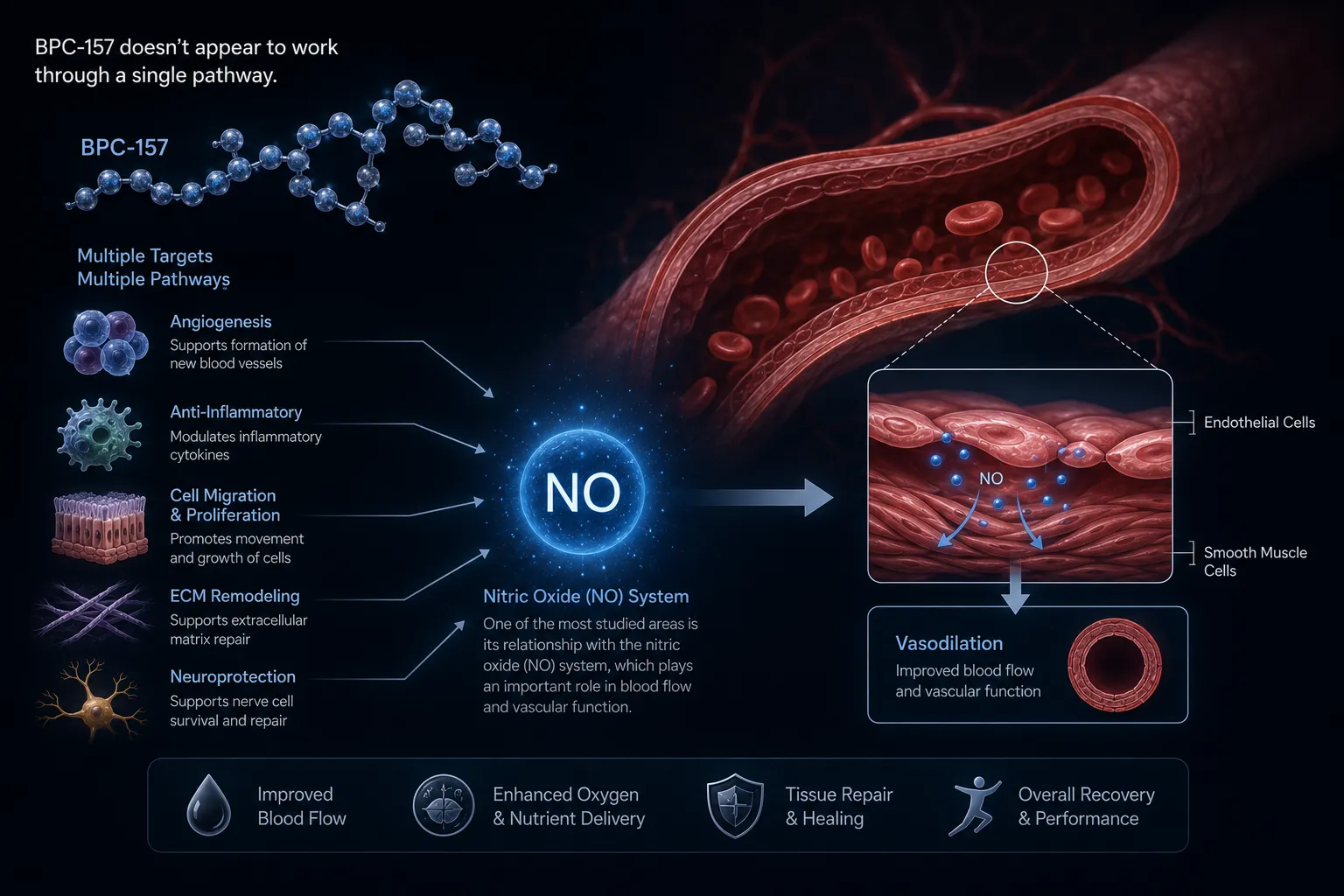
Research has also explored BPC-157's effects on:
Angiogenesis — the formation of new blood vessels
Fibroblast activity
Collagen and extracellular-matrix processes
Growth-factor signaling
Inflammatory pathways
Endothelial function
Tissue regeneration
This is particularly interesting for tissues such as tendons and ligaments, where blood supply can be relatively limited and recovery can be slow.
Much of this evidence comes from preclinical research, however.
That distinction matters.
A biological effect observed in a laboratory model can explain why researchers are interested in a compound, but it doesn't automatically establish that the same effect will occur in humans.
Why Is BPC-157 So Popular for Recovery?
The biggest reason is simple:
People are interested in repairing things that normally take a long time to heal.
Tendons.
Ligaments.
Muscle injuries.
Soft tissue.
Skin.
The gastrointestinal tract.
Preclinical studies have repeatedly produced interesting findings in these areas.
Animal studies have investigated BPC-157 in tendon injuries, muscle injuries, ligament damage, bone healing, skin wounds, and gastrointestinal injury, with many reporting accelerated healing or improved tissue outcomes.
This is why BPC-157 has developed such a strong reputation in sports and recovery communities.
But there's an important distinction between “the research is promising” and “we know exactly how effective it is in people.”
We're not there yet.
BPC-157 and Tendon Recovery
Tendons are one of the areas where BPC-157 gets the most attention.
Preclinical research has explored BPC-157 in models of tendon injury and has reported effects involving tendon healing, fibroblast activity, blood-vessel formation, and tissue organization.
The reason this is interesting is that tendon injuries can be frustratingly slow.
Unlike some muscles, tendons have relatively limited blood supply, and recovery can take weeks or months depending on the injury.
BPC-157's proposed effects on angiogenesis and tissue remodeling provide a biological reason researchers are interested in it.
And now, importantly, human research is beginning to move into this exact area.
A registered clinical trial is currently investigating subcutaneous BPC-157 in people with acute Grade II hamstring strains, alongside a standardized rehabilitation program. The study is designed to compare BPC-157 with placebo and assess recovery over several weeks, including return to activity and recurrence.
That's exactly the kind of research the BPC-157 field needs.
BPC-157 and Gut Health
The gastrointestinal tract is another major part of the BPC-157 story.
The peptide's research history is closely connected to gastrointestinal biology, and preclinical studies have investigated its effects in models of ulcers, intestinal injury, inflammatory conditions, and other forms of gastrointestinal damage.
Researchers have also investigated BPC-157 in relation to inflammatory bowel disease.
Interestingly, one of the early clinical development programs explored BPC-157 under the development code PL 14736 in inflammatory bowel disease.
However, modern evidence reviews emphasize that the human clinical evidence remains very limited and that the majority of the published research is still preclinical.
So while the gut-health story is one of the reasons BPC-157 became scientifically interesting, it should not be confused with having an established clinical indication for gastrointestinal disease.
What Does the Human Research Say?
This is where the BPC-157 story gets particularly interesting in 2026.
For years, almost all of the excitement around BPC-157 came from laboratory and animal research.
There are now a small number of published human pilot studies.
One 2024 pilot study involved 12 women with interstitial cystitis who received a local BPC-157 treatment. The researchers reported improvements in symptoms and no adverse events during the study. However, this was a very small, uncontrolled study, so it cannot establish efficacy on its own.
A separate 2025 pilot study evaluated intravenous BPC-157 in two healthy adults. The participants received infusions of 10 mg and 20 mg on separate days, and no adverse effects were reported during the observation period. Again, the sample was only two people, so this is preliminary safety information rather than proof of effectiveness.
A recent 2026 review summarized the published human evidence as consisting of only a handful of small, uncontrolled studies involving fewer than 30 participants overall.
So where does that leave us?
The human evidence is early — but it is no longer accurate to say there is no human research at all.
That is an important distinction.
How Long Does BPC-157 Take to Work?
BPC-157 is generally discussed as a recovery-focused peptide, so the timeframe people are interested in is usually tied to the underlying issue rather than a specific weight or aesthetic milestone.
People commonly report noticing changes in recovery, discomfort, mobility, or training tolerance over the course of several weeks, with more noticeable recovery often developing around 4–8 weeks depending on the situation.
For an acute injury, the underlying injury itself remains the biggest variable.
A minor soft-tissue issue and a significant tendon injury obviously won't follow the same timeline.
The emerging clinical research is also evaluating recovery over several weeks rather than expecting an overnight effect. The current hamstring trial, for example, assesses participants at Days 3, 7, 14, 28 and 56, with additional follow-up afterward.
So the practical way to think about BPC-157 is:
weeks, not days.
And the goal isn't necessarily to “feel the peptide.”
It's to see whether the underlying recovery process is progressing.
BPC-157 vs. TB-500
BPC-157 and TB-500 are often mentioned together because both have become popular in recovery and regenerative-peptide circles.
They aren't the same peptide.
BPC-157 is a 15-amino-acid peptide with research focused heavily on tissue protection, vascular biology, gastrointestinal injury, and musculoskeletal recovery.
TB-500 is a synthetic peptide related to thymosin beta-4, a protein involved in processes such as cell migration, angiogenesis, and tissue repair.
Both have interesting preclinical research.
Neither has the kind of large, definitive human clinical evidence that exists for established medicines.
This is why they are often discussed together in recovery protocols even though their biological mechanisms are not identical.
BPC-157 and GHK-Cu
This is another combination people frequently ask about.
GHK-Cu is primarily associated with skin, collagen, extracellular-matrix remodeling, and tissue repair.
BPC-157 is more commonly discussed around systemic recovery, soft-tissue repair, tendon and ligament recovery, and gastrointestinal biology.
Because their areas of interest overlap but aren't identical, people often discuss using them together as part of a broader recovery or repair approach.
The scientific literature does not yet establish that the combination produces better outcomes than either peptide alone.
But the concept makes biological sense enough that it has become one of the more commonly discussed peptide combinations.
What Are the Potential Benefits of BPC-157?
The main areas researchers are investigating include:
Tissue repair
BPC-157 has produced extensive preclinical findings involving tissue healing and protection.
Tendon and ligament recovery
Animal research has explored effects on tendon healing, fibroblast activity, angiogenesis, and tissue organization.
Muscle recovery
Preclinical models have investigated BPC-157 in muscle injury and repair.
Gut health
BPC-157 has a long research history involving gastrointestinal injury and inflammation.
Blood-vessel formation
Angiogenesis is one of the recurring mechanisms investigated in BPC-157 research.
Wound healing
Researchers have investigated its effects on skin and other tissue injuries, with human wound-related research still developing.
The important word across all of these areas is potential.
The preclinical story is broad.
The human story is still being written.
What About Side Effects?
This is one of the areas where we have to be particularly honest about the evidence.
Small human studies published so far have not reported major adverse effects, including the two-person IV safety pilot and the 12-person interstitial-cystitis study.
But that does not mean BPC-157 has a fully established safety profile.
A handful of small studies cannot detect uncommon or long-term adverse effects.
The FDA has also identified concerns about the potential for immunogenicity and peptide-related impurities and has noted that safety information for proposed compounded routes is limited.
This is particularly relevant for injectable products, where identity, purity, sterility, endotoxin control, and manufacturing quality become important considerations.
So the honest answer is:
Early human exposure has not revealed a major safety signal in the small studies published so far, but long-term human safety remains insufficiently characterized.
BPC-157 in the Philippines
Interest in BPC-157 Philippines has grown rapidly, particularly among people interested in injury recovery, training, sports performance, and tissue repair.
It is now one of the most frequently discussed research peptides in Philippine peptide communities, alongside compounds such as GHK-Cu and TB-500.
The regulatory conversation is also evolving.
In July 2026, the FDA's Pharmacy Compounding Advisory Committee reviewed BPC-157-related substances for possible inclusion on the U.S. 503A bulk drug list. The committee's vote was advisory; it did not make BPC-157 FDA-approved. The FDA stated that it would consider the committee's input before making a final determination.
This is an important distinction:
Compounding status and FDA approval are not the same thing.
For anyone researching BPC-157 in the Philippines, local regulatory requirements and the status of individual preparations can differ from the U.S. framework.
Product quality also matters enormously with an investigational peptide. A vial labeled BPC-157 isn't, by itself, proof of identity, purity, sterility, or potency.
Frequently Asked Questions
BPC-157 is a synthetic 15-amino-acid peptide that has been extensively studied in preclinical models of tissue repair, gastrointestinal injury, inflammation, vascular function, and recovery.
BPC-157 is commonly explored in peptide and recovery communities for tissue repair, tendon and ligament recovery, muscle recovery, wound healing, and gastrointestinal support. However, it does not currently have an established FDA-approved clinical indication.
Preclinical studies have produced encouraging findings involving tendon healing and tissue remodeling, which is one of the main reasons BPC-157 is popular in recovery circles. Human evidence is still limited, and controlled trials are now beginning to investigate musculoskeletal injuries directly.
BPC-157 is generally discussed as a gradual recovery peptide. People commonly look for changes over several weeks, with 4–8 weeks often discussed as a practical timeframe for noticing recovery-related changes. The timeline depends heavily on the injury or condition being addressed.
BPC-157 has a substantial preclinical research history involving gastrointestinal injury and inflammation. Human evidence is much more limited, so its potential role in gut health remains an area of investigation rather than an established treatment.
Yes. BPC-157 and GHK-Cu are commonly discussed together because they have overlapping but different areas of interest: BPC-157 around systemic recovery and tissue repair, and GHK-Cu around collagen, skin, and connective-tissue remodeling. Specific combinations should still be considered thoughtfully.
Yes. BPC-157 and TB-500 are commonly combined in recovery-focused peptide protocols because both are associated with tissue-repair research, although they work through different biological pathways. Clinical evidence establishing that the combination is superior to either peptide alone is currently limited.
Yes. Although most BPC-157 research remains preclinical, several small human pilot studies have now been published, including research involving interstitial cystitis and intravenous administration. A controlled trial is also investigating BPC-157 for acute hamstring injury.
Final Thoughts
BPC-157 is one of those peptides where the gap between scientific interest and clinical evidence is part of the story.
The preclinical research is extensive and genuinely fascinating. Researchers have investigated everything from tendon and muscle repair to gastrointestinal injury, blood-vessel formation, inflammation, and tissue protection.
For years, however, the human evidence lagged far behind the enthusiasm.
That is beginning to change.
Small human studies have now been published, and controlled research is moving into areas such as acute sports injuries.
We're not at the point where BPC-157 can be described as a proven treatment for every recovery problem people discuss online.
But we're also well past the point of saying “there's no human research.”
The more interesting position is somewhere in between:
BPC-157 has a remarkably compelling repair story — and science is finally starting to test how much of that story holds up in humans.
This article is for general education and does not constitute medical advice. Speak with your care team or a qualified healthcare professional before acting on anything here.
Explore the BPC-157 Protocol
Want to explore BPC-157 beyond the research? Learn more about the YRT protocol, including what it is, how it fits within the YRT system, and what to know before taking the next step.